


logo

Programme Starts:
28th February, 2026

Programme End:
August, 2026

Duration:
06 Months

ELIGIBILITY CRITERIA

  • Graduation or Diploma holders in any discipline

Class Schedule

  • Saturday 10:00 AM to 01:30 PM (IST)

Programme Overview

Product management is the voice of the market inside the company. A product manager is the one who is responsible to articulate what success looks like for a product or service keeping in mind the needs of the customer and the larger business objective. They take care of the end-to-end lifecycle of a product or service like planning, developing, launching, and managing to yield optimal profits for the company.

IIT Delhi's Executive Programme for Advanced Product Management helps you to hone your product management skills by providing you hands-on experience on customer delivery, equipping you with state-of-the-art prototype development processes and tools for both physical and digital products. It will help you build a robust product management capability extensively from an organisational and industry perspective, which are anticipated to be valuable for product success and start-ups.

Programme Highlights

Programme by DMS, IIT Delhi
Ranked #4 in the (Management 2025) NIRF rankings, 1st in QS World University Southern Asia Rankings 2025 in India.

Hands-on experience with customer discovery

State-of-the-art prototype development processes and tools

6-month online programme for working professionals

60 hours of live online sessions by IIT Delhi faculty and industry experts

IIT Delhi Continuing Education Programme (CEP) Certificate


TOOLS

Programme Curriculum

Module 1: Introduction to Product Management

  • Product Management – Skills Required, Hierarchy, Job Description, Types of PM Across Industry, Intro to Product Management Tools

Module 2: Product Strategy

  • Product, Service, Platform – Layers of Product, What Is a Product? Difference Between Product, Service, and Platform? Minimum Viable Product (MVP), Product Lines & Product Portfolio, Defining Product Vision and Mission, Creating a Product Roadmap
  • Product Strategy – Product Mix, Marketing Mix, Marketing Plan and Marketing Strategy, B2B vs. B2C Strategy for Products, Services and Platforms, Competitive Analysis and Benchmarking

Module 3: Product Development

  • New Product Development – Stage Gate Process, Hardware vs. Digital Product Development, Do’s and Don’ts of NPD Process, Cross-functional Team Collaboration, Lean and Agile Methods, Product Development Lifecycle, Non Digital Products Development

Module 4: Product Design and Discovery

  • UI/UX for PM – Product Specifications and Features, Visual Design Elements
  • UI/UX for PM – User Experience (UX/UI) Design, Introduction to Software Tools
  • UI/UX for PM – A/B Testing, Feedback Loop, Prototype Development for Digital Products
  • Design Thinking – For Products, Services and Platforms
  • Design of Non Digital Products

Read More >

Module 5: Product Validation & Testing

  • Functional Testing: Ensuring the Product Performs as Intended
  • Non-Functional Testing: Assessing Performance, Usability, and Reliability
  • User Acceptance Testing (UAT): Testing by End-users to Ensure It Meets Their Needs
  • Regression Testing: Verifying That New Changes Haven’t Adversely Affected Existing Features
  • Stress and Load Testing: Evaluating Product Performance Under Extreme Conditions
  • Overview of Popular Testing Tools (e.g., Selenium, JIRA, TestRail), Use of Version Control and Integration Tools in Testing, Emerging Technologies in Testing Like AI and Machine Learning, Successful Product Validation and Testing Strategies, Documentation for Compliance for Audits and Certifications

Module 6: Product Lifecycle & Product Line Decisions

  • Definition and Stages of the Product Lifecycle: Introduction, Growth, Maturity, and Decline
  • Importance of Understanding the Product Lifecycle for Strategic Planning
  • Relationship Between Product Lifecycle and Product Line Management
  • Product Line Decisions – Line Stretching, Line Pruning, Line Filling, Upward, Downward and Two-way Decision Strategies
  • Managing Product Lifecycle, Life Cycle of Digital and Non Digital Products

Module 7: Product Engineering

  • Phases of Product Engineering – Product Ideation, Product Architecture, Product Migration and Porting, Technical Support

Module 8: Product Marketing and Launch

  • Product Launch Steps and Timing – Product Launch Process, Marketing Do’s and Don’ts, STP Strategies, Target Marketing, Go-to-Market Strategy, Analytics-based Decision Making

Module 9: Product Analytics

  • Data Science Analytics for Product Decision Making, Marketing Analytics, Identifying High-value Customer Segments, Predictive Modelling for Customer Behaviour and Preferences, Competitive Pricing Analysis Using Market Data, Revenue Optimisation Through Pricing Experiments and A/B Testing, Predicting Product Success and Market Demand With Data Models, Key Concepts: Big Data, Machine Learning, Predictive Analytics, and AI

Module 10: Product Growth and Scaling

  • Product Monetisation Frameworks and Strategies – Acquisition and Retention Strategies, Action Plan for Sustained Growth

Module 11: Product Monetisation

  • Product Monetisation Frameworks and Strategies – Monetising Current and Potential Users, Revenue Models and Pricing Strategies, Evaluating and Optimising Revenue Streams

Module 12: Product Leadership

  • Product Leadership Frameworks and Strategies – Strategic, People and Execution Leadership, Building a Product Vision and Culture

BONUS

  • Career Assessment
  • Career Assistance
  • Interview Preparation

Read Less <

Career Services

Personal Branding – 1

  • Introduction to networking platforms
  • Profile creation on professional networking platforms like LinkedIn, Lunchclub etc.

Personal Branding – 2

  • LinkedIn Profile Review
  • How to create personal brand presence on LinkedIn?
  • How to increase post engagement on LinkedIn?
  • Active networking

Business Communication – 1

  • Role and importance of effective communication as a leader
  • The art of providing constructive feedback for successful team

Read More >

Business Communication – 2

  • Importance of non-verbal communication
  • Key elements of executive body language

Job Search Strategy – 1 Resume Creation

  • Importance of creating ATS friendly executive resume
  • Executive resume sections and structure
  • Tailoring resumes for different roles and industries
  • Write a powerful resume that stands out from the competition

Job Search Strategy – 2 Resume Review

  • Peer to peer review and Q&A

Interview Preparation Pre-Interview Etiquettes

  • Learn about top-down approach for interviews
  • Pre-interview tips and tricks

In-Interview Etiquettes

  • Create a self-elevator pitch
  • Understanding interviewer mindset
  • Interview grooming sessions & tips and tricks for interview

Post-Interview Etiquettes

  • Reflecting on interview experience & incorporating the feedback
  • Relationship building with the recruiter
  • Learn how to follow up on your job application

Read Less <

CERTIFICATION

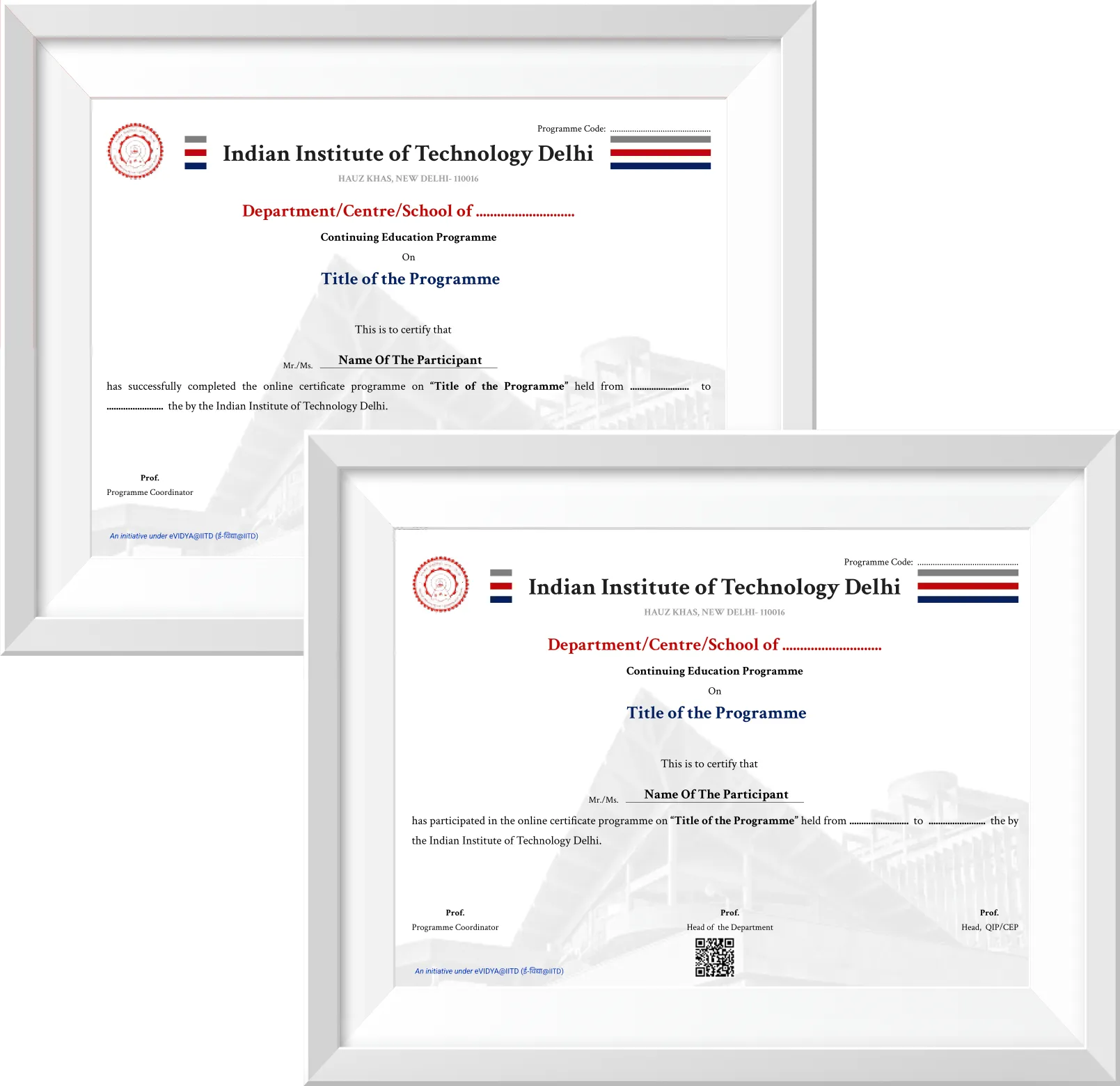
  • Candidates who score at least 60% marks overall and have minimum attendance of 50% will receive a ‘Certificate of Successful Completion’ from CEP, IIT Delhi.
  • Candidates who score less than 60% marks overall and have minimum attendance of 50% will receive a ‘Certificate of Participation’ from CEP, IIT Delhi.
  • The organising department for this programme is the Department of Management Studies.

Note: For more details download brochure.
MEET OUR PROGRAMME FACULTY

Prof. Biswajita Parida
Associate Professor, DMS, IIT Delhi

Prof. Biswajita Parida is an Associate Professor in Marketing at the Department of Management Studies at IIT Delhi. She is a fellow of the Indian Institute of Management Ahmedabad (IIM A). She has taught at various B-schools including XLRI Jamshedpur, IIM Sambalpur, and NMIMS Mumbai. Her research interests are in the area of Consumer Behaviour, Advertising, and Branding (Advertising scheduling and placement, Children and Advertisement, Meaning making: of the brands, by the brands, and for the brands, Consumer decision making under pressure of time, place, and company). She has presented and published her work at various national and international forums.

Read More >

Her teaching interests include Integrated Marketing Communication, Product and Brand Management, Evolution of Consumer Behaviour, Marketing Management, Technology and Marketing. She has run successful CEP programmes like “New Product Development and Management”, “Executive Programme for Advanced Product Management” and “Executive Programme for Tech Product Management” which received overwhelming response from participants. She was a participant at Global Colloquium on Participant-Centered Learning (GLOCOLL 2024) at the Harvard Business School (HBS), Boston, USA. She is a proud recipient of the “Teaching Excellence Award” at IIT Delhi. More details at https://www.biswajitaparida.com

Read Less <

Programme Fees

₹1,69,000 + GST

(Installment available)

Admission Criteria

Admission to the program is based on a comprehensive review of your application.